
See What Your Decision Is Really Up Against.
LOOKUP helps consultants, advisors, and decision professionals work through complex business situations and come away with analysis and recommendations they are prepared to act on.
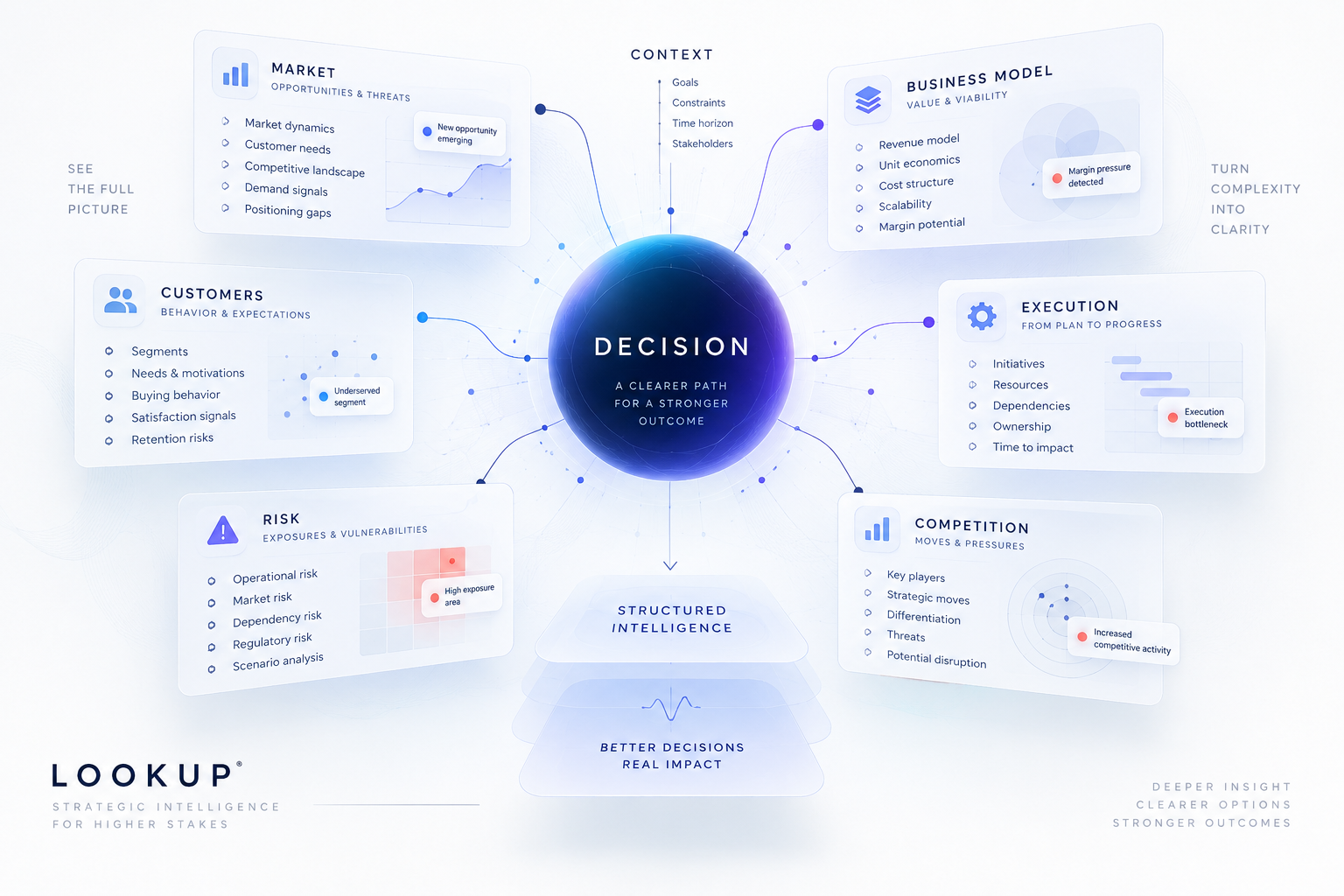
The Decision Visibility Gap
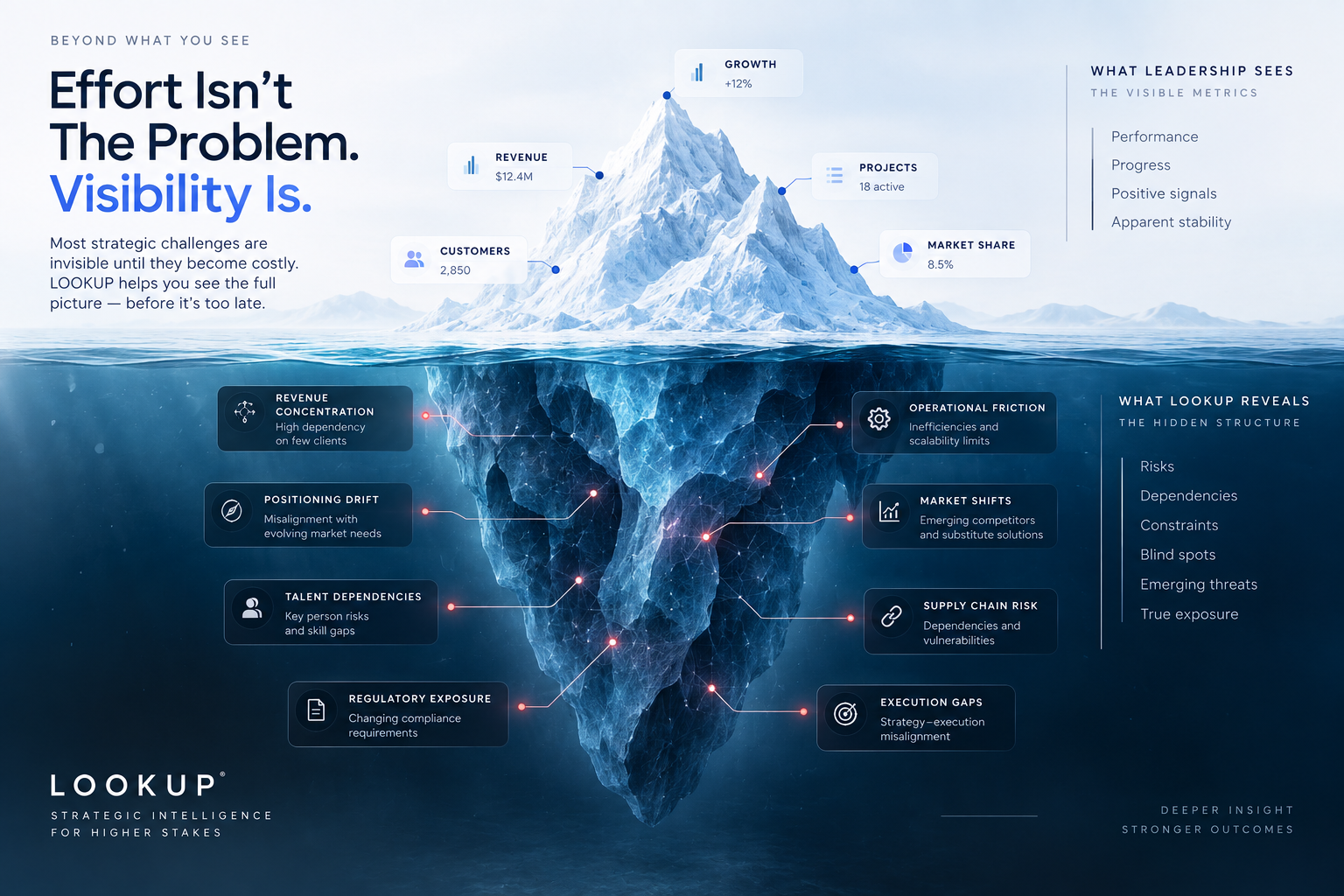
Effort Isn't The Problem. Visibility Is.
Damage rarely shows up right away: a wrong assumption in the plan, positioning that's drifted from the market, priorities pulling teams apart. By the time it's visible, it's already cost time, margin, or momentum.
LOOKUP catches these issues while they're still cheap to fix, and shows you exactly what to do next.
The Three Layers Of Decision Intelligence
Three Intelligence Pillars
Eight specialized engines. Three ways to strengthen a decision.
Strategic Intelligence
Catch flawed assumptions and structural risk before they get expensive.
Market Intelligence
See whether your positioning still matches how the market buys.
Execution Intelligence
Turn a decision into sequenced work with clear ownership.
What You Can Diagnose
Featured Use Cases
Strategic Repositioning
Detect when your market position no longer matches the business reality.
Learn MoreStructural Risk Analysis
Find the revenue concentration and fragile dependencies most plans never account for.
Learn MoreFunnel Diagnostics
Locate conversion leakage and friction across the customer journey.
Learn MoreExecution Planning
Sequence the work, assign ownership, and keep the plan moving instead of sitting in a deck.
Learn MoreA Structured Decision Workflow
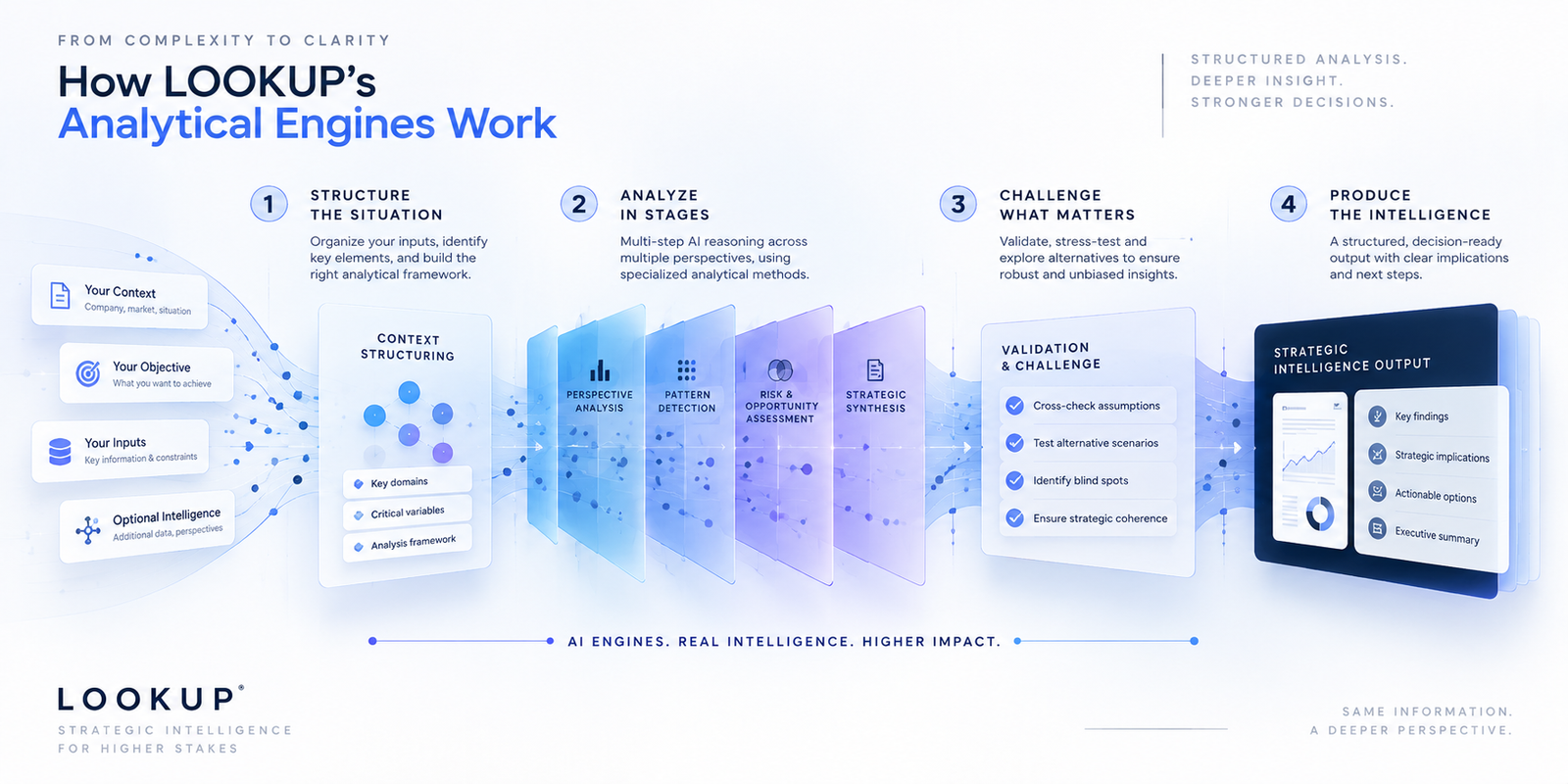
How The Engines Work
Each engine follows a defined analytical process built for the problem it is designed to solve.
A Library Of Executive Intelligence
Featured Intelligence Outputs
The reports below are representative outputs generated with LOOKUP. Each one is built to stand on its own in front of a client, and demonstrates a different category of strategic analysis available on the platform.
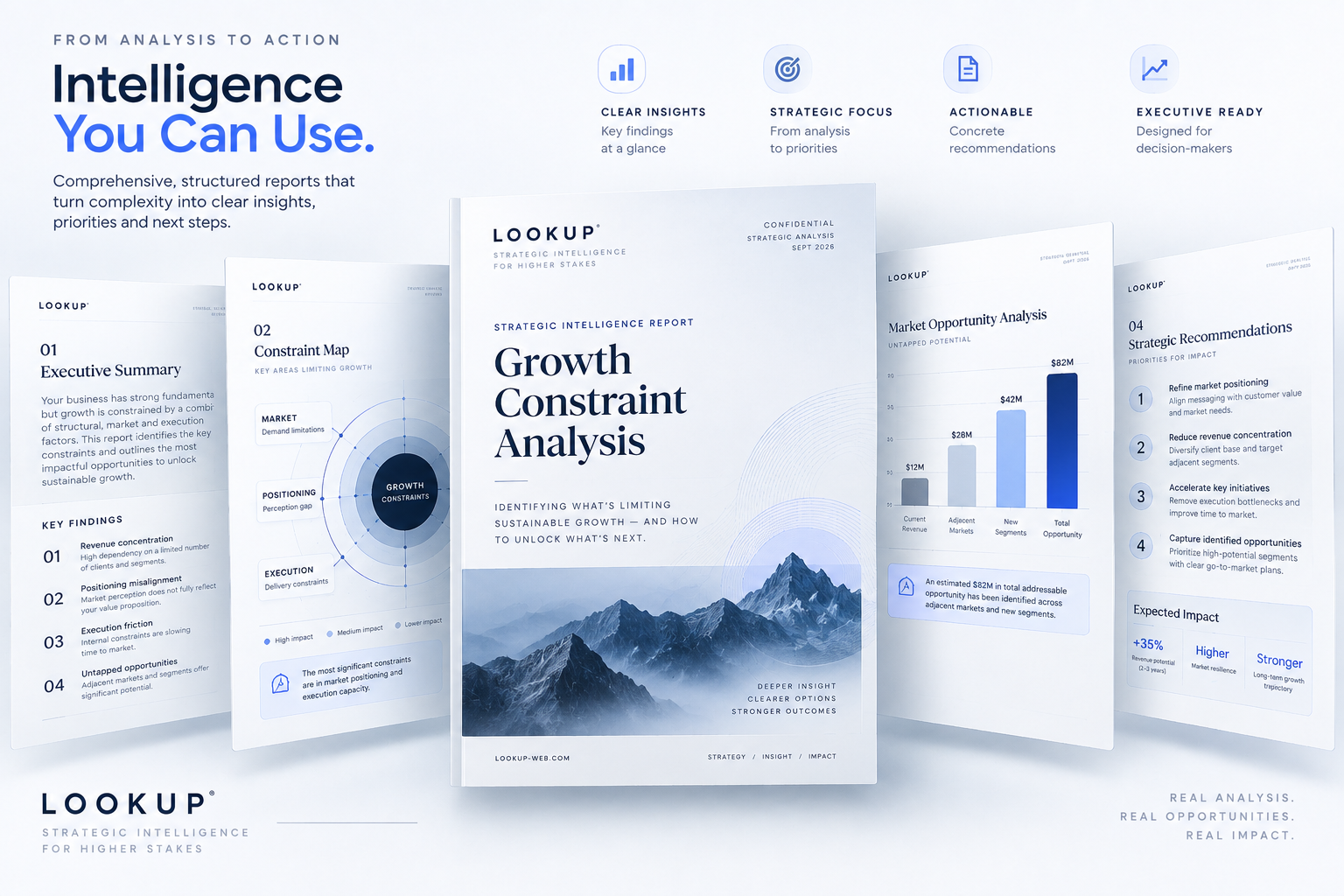
Growth Constraint Analysis
Identify the structural constraints limiting sustainable business growth.
Preview Report →Strategic Vulnerability Assessment
Reveal the hidden business risks that leadership usually only discovers the hard way.
Preview Report →Offer Differentiation
Evaluate competitive positioning, customer perception and value proposition clarity.
Preview Report →Initiative Structuring
Give a complex initiative the execution structure a team can actually run with.
Preview Report →General-Purpose AI vs. LOOKUP
Not Just AI. An Analytical System.
Ask a general-purpose AI model a question and it will answer immediately, drawing on one broad reasoning pass. LOOKUP runs the question through a defined analytical process instead.
General-Purpose AI
- Open-ended prompt
- One broad reasoning path
- AI-generated calculations
- First conclusion
- Generic output
LOOKUP
- Structured analytical workflow
- Specialized analytical stages
- Independent logic where required
- Adversarial review where designed
- Structured professional deliverable
LOOKUP puts real structure around the analytical process, the kind that holds up when someone pushes back on the conclusion.
Not Built For Everyone
Who It Is For
LOOKUP is built for professionals whose job is to make sense of complex situations and give the people around them something solid to decide on.
Primary users
Consultants & Advisors
Run rigorous analysis across client engagements and back every recommendation with reasoning that holds up under scrutiny.
Fractional Executives & Specialists
Bring the same repeatable analysis to every mandate, whether it is a turnaround, a growth push, or a transformation program.
Built for the decisions they support
Finance & Investment Leaders
Pressure-test business models, risk, and value before capital is committed.
Board & Executive Advisors
Bring structured evidence to strategic reviews and high-stakes decisions.
Founders & Leadership Teams
Often the people an analysis is ultimately prepared for, even when a consultant or advisor is the one running it.
Frequently Asked Questions
FAQ
Is LOOKUP just another AI tool?
No. LOOKUP is built around specialized analytical engines rather than open-ended AI prompting. Each engine follows a defined workflow designed for a specific analytical problem and deliverable.
How is this different from using a general-purpose AI model?
General-purpose AI is flexible by design. LOOKUP takes a different approach. It breaks the analysis into defined stages, gives each stage a narrow reasoning task, and adds independent checks or calculations where the engine is built to do that.
Are the results calculated by AI?
Not always. Where an engine depends on specific calculations or scoring, the system can independently recompute those values rather than relying solely on the model's generated output.
What is business model assessment?
It evaluates revenue mechanics, cost structure, and dependencies to see whether the model can scale.
How does scenario planning help you decide?
It prepares you for plausible futures, so you can respond faster when conditions change.
What does execution planning improve?
It clarifies what to prioritize, in what order, and who owns each piece, so the strategy actually gets executed instead of staying on paper.
Why does value proposition analysis matter?
It shows how clearly the market understands your offer, and where the messaging is costing you conversions.
Can LOOKUP help with business risk analysis?
Yes. It surfaces hidden vulnerabilities, concentration risk, and bottlenecks that a standard review typically misses.
Stop Guessing. Start Deciding.
Run your next complex decision through LOOKUP, and put real analysis in front of whoever has to sign off on it.
Choose the plan that fits your work and start generating structured, decision-ready intelligence.