
Strategic decisions define the trajectory of a company. Yet most decisions are made under uncertainty, incomplete information, and time pressure.
The Strategic Analysis & Decision Intelligence capability inside Lookup Web equips founders, executives, and consultants with advanced AI agents designed to transform complex business situations into structured strategic insights.
Instead of relying on intuition or fragmented analysis, these agents systematically evaluate business conditions, diagnose operational weaknesses, simulate risks, and produce structured strategic reports that support confident decision-making.
Whether you are evaluating a new initiative, diagnosing operational bottlenecks, or stress-testing your business model, this capability delivers the analytical clarity required for high-stakes decisions.
Within this capability, Lookup Web provides a suite of specialized AI agents designed to analyze different dimensions of business decision-making.
Analyze complex business situations and transform them into a structured strategic diagnostic. The analysis evaluates your company’s strategic position, identifies structural strengths and weaknesses, highlights key risks, and provides prioritized strategic actions.
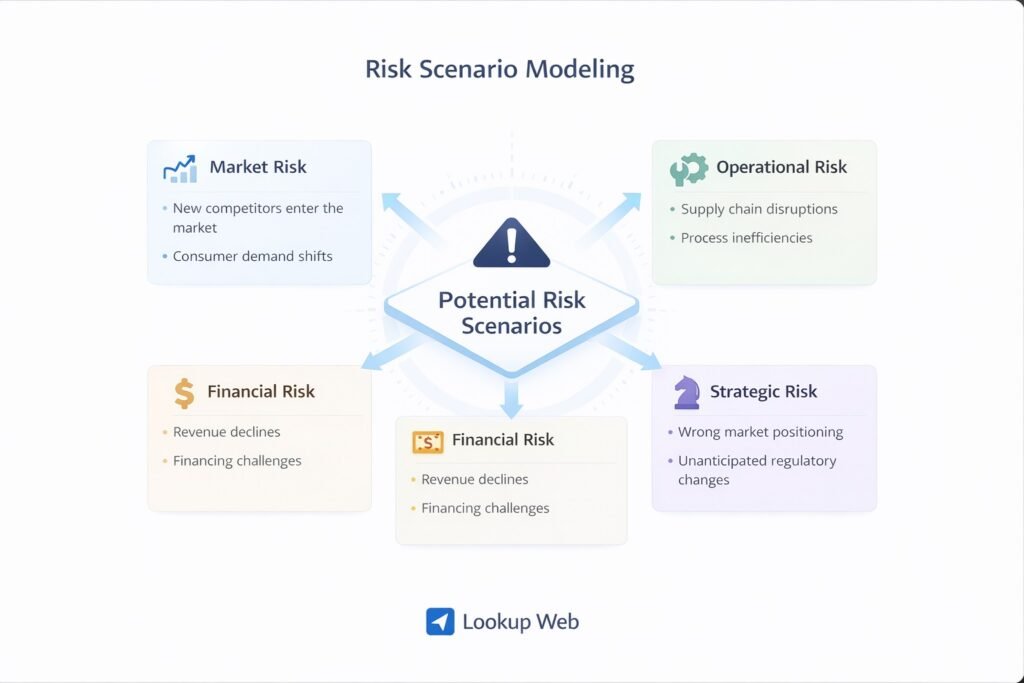
Run the Strategic Analysis AgentExplore how different future scenarios could impact your business strategy. This agent simulates potential risk environments and evaluates how market shifts, operational disruptions, or strategic changes may affect outcomes.
Explore Risk Scenario AnalysisEvaluate complex strategic choices when information is incomplete or uncertain. The agent models decision pathways, analyzes trade-offs, and helps leaders understand the potential consequences of each option.
Use the Decision Intelligence AgentAssess the resilience of your business model by identifying structural weaknesses and hidden dependencies. The analysis reveals pressure points that could threaten sustainability under changing market conditions.
Run the Business Model Stress TestStrategic Analysis & Decision Intelligence is used by founders, executives, and consultants in a wide range of situations.
Common use cases include:
Evaluating a new business initiative
Before launching a new product or entering a new market, leaders can analyze strategic risks and operational readiness.
Diagnosing stalled growth
When growth slows, operational bottlenecks or structural weaknesses often remain hidden. Strategic diagnostics reveal the underlying constraints.
Preparing for major decisions
Executives can analyze complex decision scenarios and understand potential trade-offs before committing resources.
Stress-testing business models
Organizations can evaluate how resilient their revenue structure is under changing market conditions.
Consulting and advisory work
Consultants can produce structured strategic diagnostics and reports to support client recommendations.
In fast-moving markets, strategic decisions must be made faster than ever — yet the complexity of modern businesses has increased dramatically.
Leaders are expected to make decisions involving:
market uncertainty
operational complexity
financial trade-offs
competitive positioning
long-term strategic impact
Traditional analysis methods often rely on spreadsheets, fragmented reports, and subjective interpretation. These approaches struggle to provide the speed and structured reasoning required for modern decision environments.
Strategic Analysis & Decision Intelligence solves this problem by combining structured analytical frameworks with advanced reasoning agents.
Each analysis transforms raw context into a structured diagnostic report, enabling decision-makers to understand:
the current strategic position of their organization
potential operational constraints
risk exposure across multiple scenarios
structural weaknesses in the business model
decision trade-offs under uncertainty
The result is a clearer decision landscape and a stronger strategic foundation for action.
This capability provides multiple layers of analysis designed to support complex business decision-making.
Analyze the current state of a business or initiative and identify structural strengths, weaknesses, and risks that may affect future outcomes.
The system examines the strategic context, operational structure, and competitive environment to produce a comprehensive diagnostic.
Strategic decisions often involve uncertainty. Scenario analysis allows leaders to explore multiple future possibilities before committing to a course of action.
The system evaluates alternative scenarios and highlights potential vulnerabilities, enabling organizations to anticipate challenges before they occur.
Many strategic decisions involve incomplete information. This capability models complex decision environments and evaluates possible outcomes across different assumptions.
Decision pathways are analyzed and structured to help leaders understand trade-offs and risks associated with each option.
Even well-designed business models may contain hidden structural weaknesses.
This capability tests the resilience of a business model by examining potential pressure points such as revenue dependencies, operational constraints, and market volatility.
The result is a clearer understanding of long-term sustainability.
Growth is often limited not by strategy but by operational constraints.
This analysis identifies bottlenecks within workflows, resource allocation, or organizational structures that may be limiting performance.
The resulting report highlights root causes and potential strategic improvements.
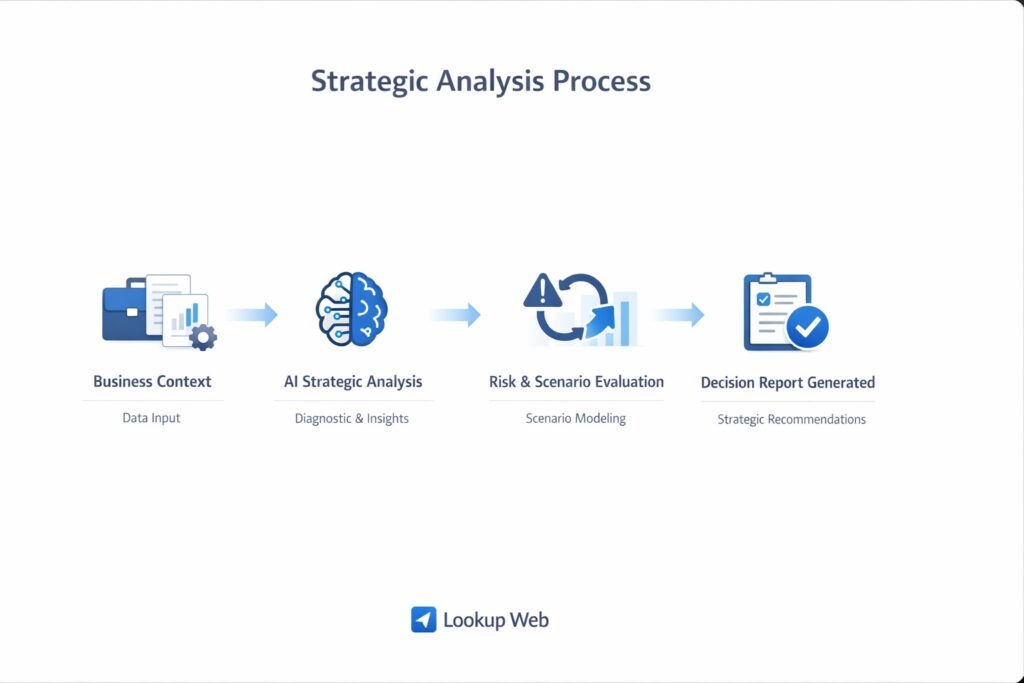
The analysis process is designed to transform business context into structured strategic insight through three systematic stages.
You provide the relevant context for the analysis, including:
business situation
strategic objective
operational challenges
market environment
decision timeframe
The system interprets this context to understand the strategic problem being evaluated.
The selected agent applies structured analytical frameworks to evaluate the situation.
Depending on the analysis, the system may perform:
strategic diagnostics
scenario simulations
operational constraint detection
business model resilience analysis
decision pathway modeling
Each analysis follows a structured reasoning protocol designed to ensure consistent results.
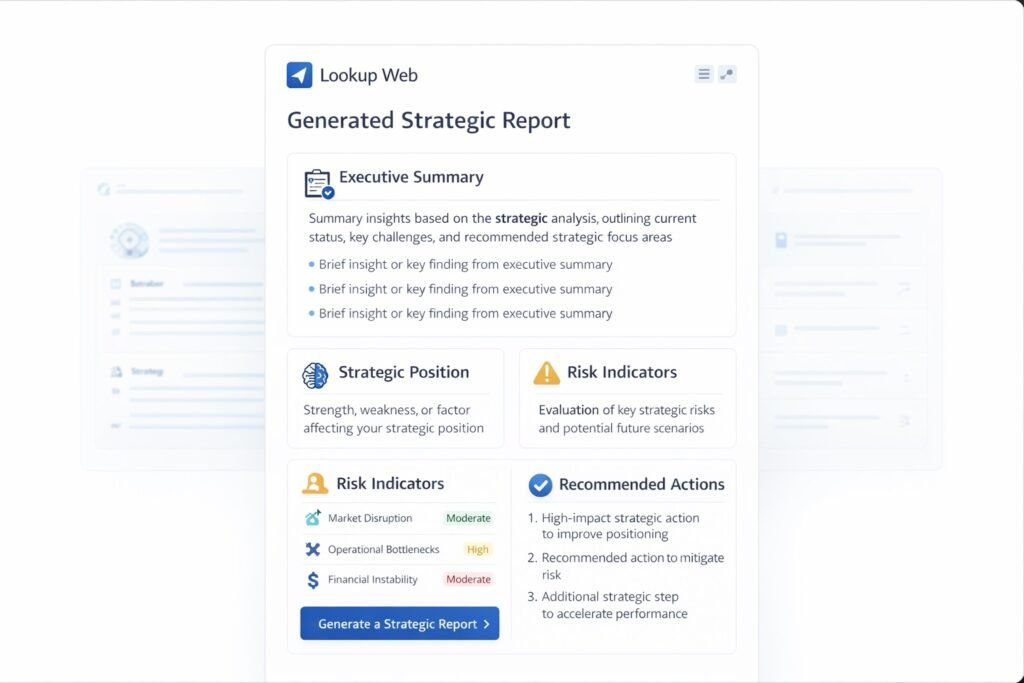
The output is delivered as a structured decision report that may include:
executive strategic summary
diagnostic insights
risk analysis
structural weaknesses
recommended actions
prioritized next steps
This report provides a clear analytical foundation for strategic decisions.
Traditional strategic analysis often involves manual frameworks, consulting workshops, or spreadsheet modeling.
While these approaches can be useful, they are often slow and inconsistent.
AI-driven analysis provides several advantages.
| Traditional Analysis | AI-Driven Strategic Analysis |
|---|---|
| Manual framework application | Automated structured reasoning |
| Time-consuming diagnostic processes | Rapid multi-layer analysis |
| Inconsistent analytical depth | Standardized analytical methodology |
| Limited scenario exploration | Structured scenario modeling |
| Subjective interpretation | Systematic decision intelligence |
By combining structured frameworks with AI reasoning capabilities, organizations can perform deeper analyses in significantly less time.
Strategic analysis is the process of evaluating a business environment, internal capabilities, and potential risks in order to make informed long-term decisions.
It helps organizations understand where they stand and what strategic actions may lead to better outcomes.
This capability is designed for:
founders
executives
strategy teams
consultants
business advisors
Anyone responsible for making complex business decisions can benefit from structured strategic analysis.
No. The system is designed to interpret business context and produce structured reports without requiring technical expertise.
Users simply provide the relevant strategic context.
The analyses rely on structured frameworks and systematic reasoning protocols.
While the results should support decision-making, they are intended to complement human judgment rather than replace it.
These agents can significantly accelerate the analytical process and provide structured strategic insights.
Many consultants use systems like this to support their analysis and prepare structured reports more efficiently.
Strategic decisions shape the future of a company. Making them without structured analysis introduces unnecessary risk.
The Strategic Analysis & Decision Intelligence capability inside Lookup Web provides founders, executives, and consultants with advanced analytical agents capable of transforming complex business contexts into structured decision intelligence.
Explore the agents within this capability and start generating structured strategic insights for your most important business decisions.