
AI Business Model Stress Test & Structural Risk Analysis Engine
Discover the structural weaknesses that could threaten your business before they become irreversible.
This executive intelligence engine goes far beyond a traditional business stress test. It evaluates the structural resilience of your business model, identifies hidden fragility, simulates realistic failure scenarios, and explains how operational, financial, and strategic risks interact over time.
Receive a board-level resilience assessment featuring the proprietary Business Model Fragility Index (BMFI), Strategic Dependency Mapping, Failure Mode Analysis, Decision Window modeling, Recovery Architecture, and a complete executive action plan designed to help founders and leadership teams protect long-term business viability.
See How a Business Model Performs Under Structural Pressure
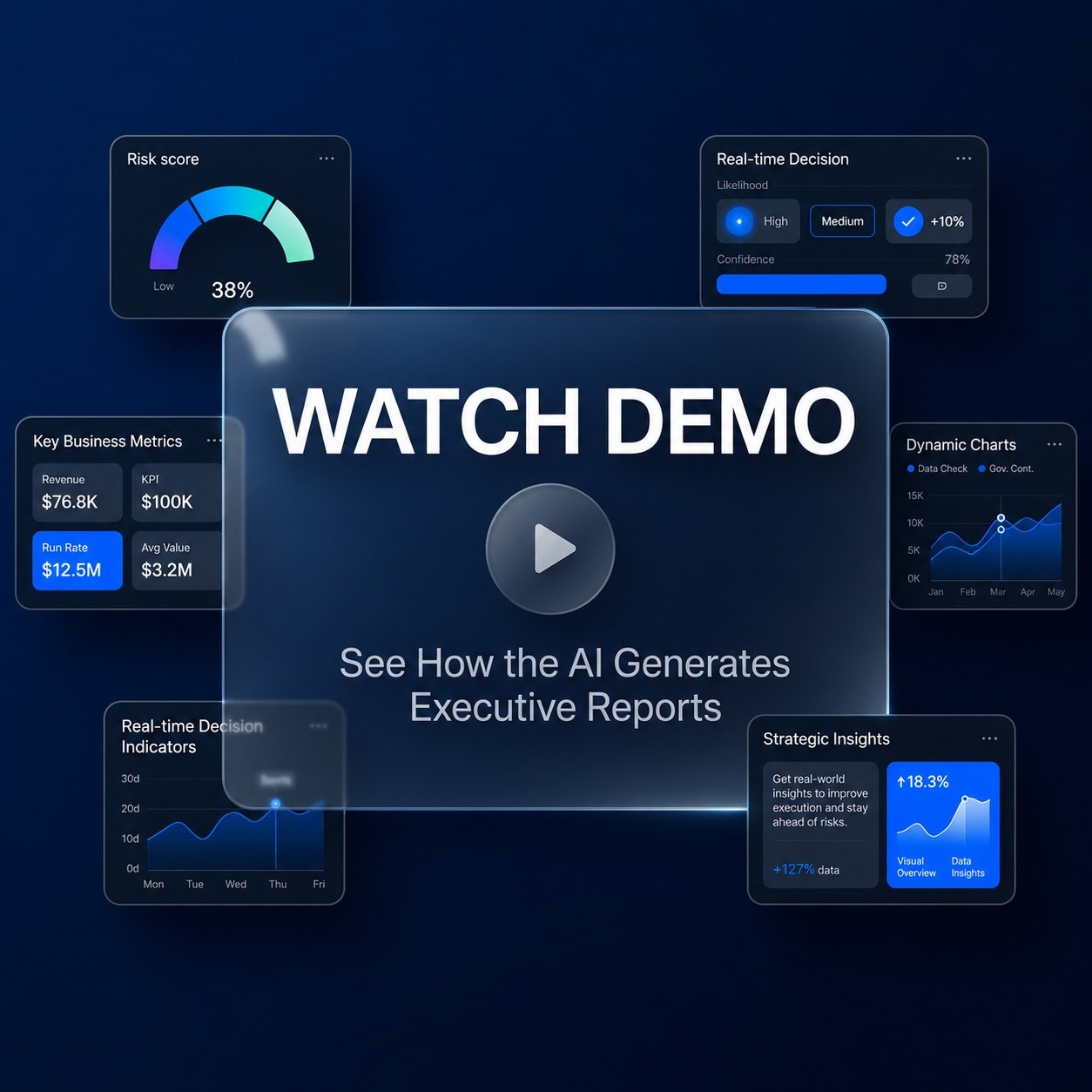
See how the Business Model Stress Test & Structural Risk Analysis Engine identifies the structural vulnerabilities behind these signals, evaluates how financial, commercial, and operational risks interact, reconstructs potential failure pathways, and determines which risks require executive attention first.
The result is a structured resilience assessment that moves beyond isolated metrics to show where the business model is most fragile, what could accelerate failure, and which structural issues leadership should address to improve long-term stability.
No company name required
- No sensitive business data required
- Your analysis remains confidential
- Start with the decision, not your identity
Start Your Assessment
Begin Analysis Session
The quality of your analysis depends on the quality of the context you provide. Take a moment to answer each question as accurately and specifically as possible. Your responses directly shape the depth, relevance, and precision of the analysis.
Your Board-Level Assessment Will Appear Here
Complete the assessment above to generate a comprehensive Business Resilience Intelligence Report designed for founders, CEOs, executive teams, and investors.
The report combines proprietary resilience frameworks with executive decision support to identify structural business fragility, quantify strategic risk, simulate recovery scenarios, and prioritize the actions that matter most.
Inside the Executive Business Resilience Assessment
Explore how the assessment evaluates structural business resilience under financial, operational, and competitive pressure to identify fragility, critical dependencies, failure modes, decision windows, and high-leverage recovery priorities.
What You'll Receive
Generate a board-level Business Resilience Intelligence Report designed to help founders, executives, investors, and advisory teams identify structural weaknesses before they become operational crises.
Rather than simply highlighting risks, the assessment reconstructs how your business model behaves under financial, operational, and competitive pressure. It identifies where resilience is strongest, where fragility accumulates, and which structural dependencies threaten long-term viability.
Your executive report includes:
- Executive Board Brief
- Business Model Fragility Index (BMFI)
- Structural Risk Assessment
- Failure Mode Analysis
- Strategic Dependency Mapping
- Decision Window Timeline
- Recovery Programs
- Strategic Outcome Simulator
- Executive Action Plan
- Board-Ready PDF Export
How the Assessment Works
The assessment combines structured business information with Lookup Web's proprietary resilience methodology to evaluate how different parts of your business interact under stress.
Instead of analyzing isolated metrics, the engine examines the relationships between revenue concentration, capital availability, operational dependencies, competitive pressure, organizational resilience, and strategic flexibility.
Using the Business Model Fragility Index (BMFI), the engine identifies the structural drivers of business fragility, models realistic failure sequences, estimates decision windows, and prioritizes recovery initiatives according to expected strategic impact.
The result is a structured executive report that explains not only what is vulnerable, but why it is vulnerable and how resilience can be restored.
Who Benefits Most
This assessment is designed for organizations making high-impact strategic decisions where structural resilience matters more than short-term performance.
Typical users include:
- Startup founders preparing for growth or fundraising
- SaaS founders managing customer concentration or cash runway
- CEOs evaluating business resilience
- Executive leadership teams reviewing strategic risk
- Fractional CFOs and turnaround advisors
- Investors performing commercial due diligence
- Strategy consultants supporting restructuring initiatives
Any organization exposed to operational, financial, or competitive uncertainty can benefit from understanding how resilient its business model really is.
When to Run an Assessment
A Business Resilience Assessment is most valuable before major strategic decisions—not after problems become visible.
Consider running an assessment when:
- Revenue growth begins to slow unexpectedly
- Customer concentration increases
- Cash runway becomes uncertain
- Preparing for fundraising
- Entering a new market
- Launching a major strategic initiative
- Scaling headcount rapidly
- Facing increased competitive pressure
- Planning acquisitions or restructuring
- Before annual strategic planning sessions
Early identification of structural fragility allows leadership teams to strengthen resilience before external shocks create irreversible consequences.
Why Business Resilience Matters
Strong businesses rarely fail because of a single event. Most failures emerge from the interaction of multiple structural weaknesses that accumulate over time.
Revenue concentration, operational dependencies, capital constraints, competitive disruption, and organizational bottlenecks often reinforce one another long before traditional financial metrics reveal a problem.
The purpose of this assessment is therefore not to predict the future, but to measure the resilience of your business model under realistic stress conditions and identify the interventions with the greatest strategic leverage.
By understanding where resilience is created—or lost—leadership teams can make better decisions, allocate resources more effectively, and reduce the probability of structural business failure.
Strengthen Your Business Before Structural Risks Become Strategic Failures
The strongest businesses are not those that avoid disruption—they are the ones that identify structural fragility before it threatens growth, financing, or long-term viability.
The Executive Business Resilience Assessment evaluates how your business performs under realistic operational, financial, and competitive pressure using Lookup's proprietary resilience methodology.
Generate a comprehensive executive report featuring the Business Model Fragility Index (BMFI), Failure Mode Analysis, Strategic Dependency Mapping, Recovery Programs, and a Board-Level Action Plan designed to support confident strategic decisions.
Business Model Stress Test FAQ
Key questions about how the engine evaluates business model resilience, identifies structural weaknesses, maps critical dependencies, analyzes failure pathways, and prioritizes actions to strengthen long-term resilience.
The Business Resilience Assessment is an executive-level analysis designed to evaluate how resilient your business model is under realistic operational, financial, and competitive pressure. Rather than focusing on isolated metrics, it identifies structural weaknesses, maps how risks interact, and provides prioritized recommendations to strengthen long-term business resilience.
Traditional business reviews typically examine current performance indicators such as revenue, profitability, or cash flow. This assessment goes further by analyzing the underlying structure of your business model. It evaluates dependency risks, structural fragility, failure pathways, decision windows, and recovery opportunities using proprietary analytical frameworks such as the Business Model Fragility Index (BMFI).
The assessment requires information about your business model, financial position, operational structure, competitive environment, growth stage, and any specific risks or scenarios you want to evaluate. Most users complete the questionnaire in approximately two to three minutes.
The assessment is designed for founders, CEOs, executive teams, investors, fractional CFOs, business consultants, and advisors responsible for strategic decision-making. It is particularly valuable for businesses experiencing growth, preparing for fundraising, managing customer concentration, or navigating significant operational change.
Your Executive Business Resilience Report includes an Executive Board Brief, the Business Model Fragility Index (BMFI), Structural Risk Assessment, Failure Mode Analysis, Strategic Dependency Mapping, Decision Window Timeline, Recovery Programs, Strategic Outcome Simulator, Executive Action Plan, interactive visualizations, and a board-ready PDF report.
No. The assessment is not intended to replace professional advisors. Instead, it provides a structured executive analysis that helps leaders identify structural risks, organize complex information, and make more informed strategic decisions. Many consultants and advisory firms can also use the report as a starting point for deeper strategic engagements.
The quality of the assessment depends on the accuracy and completeness of the information provided. The engine applies deterministic analytical frameworks, structured reasoning, and proprietary resilience models to generate consistent recommendations. The report is designed to support executive decision-making by highlighting the most significant structural risks and the actions with the highest expected strategic impact.
Because no analytical system can predict future events with certainty. Instead of forecasting what will happen, the assessment evaluates how prepared your business is to withstand different forms of disruption. By measuring structural resilience rather than attempting to predict outcomes, the report provides actionable insights that remain valuable across a wide range of future scenarios.